You've decided to start charging for calls. Good. Now you're staring at the pricing field, and your brain is doing that thing where it tries to calculate the exact dollar amount that reflects your worth, market positioning, and the state of the global economy.
Stop. Here's everything you need to know about pricing your first call: it doesn't matter nearly as much as you think.
The €50 sweet spot
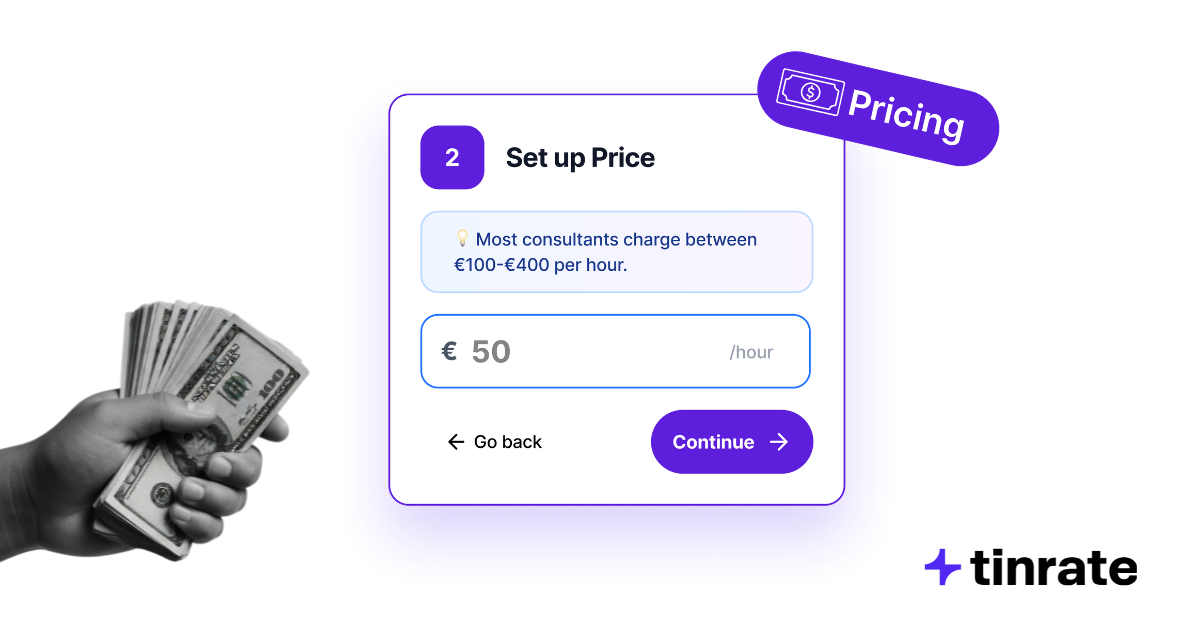
For your first paid call, set your rate between €25 and €75. That's it. If you want a single number, go with €50 for 30 minutes.
Why this range works:
- Low enough to be impulsive. €50 is a dinner out. It's not a budget decision, it's a "sure, why not" decision. Your first few bookings need to come from low friction, not perfect pricing.
- High enough to signal value. Free says "I'm not sure this is worth anything." €10 says "I'm not sure either." €50 says "this is a real thing, and my time has value."
- Easy to change later. Your first price is a hypothesis, not a commitment. You'll adjust it after your first five calls based on actual data: how quickly you book up, how much value people report getting, how your time feels.
The three pricing mistakes everyone makes
Mistake 1: Pricing based on your salary. "I make €80k, which is about €40/hour, so I should charge €40." No. Your salary reflects showing up every day. A paid call reflects concentrated, on-demand expertise. These are different things. Consultants routinely charge 3-5x their implied hourly rate.
Mistake 2: Pricing based on what you'd pay. You are not your customer. The person booking a call with you has a problem that's costing them time, money, or sleep. €50 to solve it in 30 minutes is a steal, even if you'd never spend €50 on a call yourself.
Mistake 3: Waiting for confidence. "I'll raise my price when I feel like an expert." Confidence follows action, not the other way around. Set a price, do some calls, get positive feedback, and your confidence catches up.
When to raise your rate
Here's a simple framework: if you're consistently booked more than a week out, your price is too low. Raise it by 25-50% and see what happens.
Most people on Tinrate raise their rate within the first month. Not because they suddenly became more valuable, they were always that valuable. They just needed proof.
The progression usually looks like this: €50 → €75 → €100 → €150. Each step feels scary. Each step books just as well as the last one, because value is about the outcome, not the number.
The real cost of underpricing
Charging too little isn't just leaving money on the table. It changes the dynamic of the call. At €25, people sometimes treat it casually. They show up unprepared, cancel last-minute, or don't follow through on your advice. At €100, they come with written questions and take notes.
Price shapes behavior. A higher rate doesn't just earn you more, it creates better conversations.
Just pick a number
Here's your decision tree:
If you've never charged for advice before → €50.
If you have consulting experience → €75-100.
If you're already known in your field → €100-150.
Set it. Publish it. Do five calls. Then decide if the number is right.
The perfect price doesn't exist. The published price does.
Set your rate and publish your first offer on Tinrate. It takes less than 5 minutes.