You spent money getting people to your website.
The ads worked. The SEO is improving. Someone clicked your LinkedIn post and actually read it. Traffic is coming in.
And then nothing.
No form filled. No email received. No call booked. Just a number in Google Analytics that tells you people showed up and a silence that tells you they left.
97% of B2B website visitors leave without converting. Not because your product is wrong. Not because your pricing is off. Because your website gave them nowhere to go except a contact form and nobody fills those out anymore.
Here is why that happens, what it is actually costing you, and the one thing that fixes it.
Why visitors leave without doing anything
They had a question. Your website had a brochure.
Think about the last time you visited a company's website because you were genuinely interested in what they do. You landed on the homepage, read the headline, scrolled through the features page, maybe clicked "About us" and then what?
You probably had a specific question. Something like "does this integrate with the tool I already use?" or "how long does it take to get started?" or "is this built for a company my size?"
And the answer was not on the page. So you left to find it somewhere else: a competitor's site, a Reddit thread, a ChatGPT conversation. The company never knew you were there. They never knew what you needed. And they definitely never heard from you again.
This is not a rare scenario. This is what happens to 97 out of every 100 visitors on most B2B websites. The product was probably right. The timing was probably right. The visitor just had nowhere to land except a generic contact form that felt like it would take three days to get a reply from.
Contact forms are a waiting game nobody wants to play anymore
There is a reason contact form conversion rates are so low. Filling out a form means:
- Writing a paragraph explaining who you are and what you need
- Waiting an unknown amount of time for a reply
- Getting a reply that asks for more information
- Waiting again
- Maybe scheduling a call for sometime next week
Buyers in 2026 do not have that kind of patience. They are used to getting answers immediately from ChatGPT, from Google, from any tool that respects their time. A contact form is the opposite of immediate. It is a signal that says "we will get back to you eventually."
And most of the time, by the time you do get back to them, the moment has passed.
A lead is 60x less likely to qualify if you wait 24 hours to respond (Harvard Business Review / MIT Oldroyd study). Not a little less likely. 60 times less likely. That is the cost of the waiting game.
Your best leads never identify themselves
Here is the thing that stings. The visitors who leave silently are often your best prospects. The ones who browse for 8 minutes and read three pages before leaving, they were interested. They just did not find a reason to raise their hand.
The contact form rewards the most determined visitors, the ones who will jump through hoops regardless. But the majority of high-intent visitors, the ones who were genuinely curious but not yet fully committed, disappear. And you never know they were there.
Of the leads that do come through, only 8% are the right fit, right timing, and ready to buy. The rest are wrong fit, wrong moment, or just curious. So you are chasing a lot of noise to find a little signal — and you are doing it blind, because you have no visibility into what the other 92 visitors out of 100 actually wanted.
What this is costing you (beyond the obvious)
The lost conversion is the obvious cost. But there are three other costs that are just as real and rarely talked about.
You are flying blind on your own market.
When someone searches for your company on ChatGPT or types a question about your product into Google, you never see that query. It happens somewhere else and you get no data from it. You do not know what objections your market has. You do not know which features they care about. You do not know what is confusing them.
You are making product decisions, pricing decisions, and content decisions based on the small percentage of people who filled out a form, while the vast majority of your market's questions are invisible to you.
Your sales team is going into calls cold.
When a lead does come through a form, your sales rep has a name, a company, and a vague one-line description of what they need. That is it. The rep has to spend the first 15 minutes of every discovery call asking questions the visitor already answered in their own head while they were on your website.
It is inefficient and it makes a bad first impression. The visitor has been thinking about your product for days. Your rep is meeting them for the first time.
You are paying for traffic that never had a chance.
Every visitor who lands on your site and leaves without engaging represents a real cost, whether that visitor came from paid ads, organic search, social, or referral. When 97% of them leave without converting, the cost per acquired lead is not what your ad platform tells you it is. It is significantly higher, because most of that spend is going to traffic that never had a conversation with you.
What actually fixes it
The fix is not a better contact form. It is not a longer landing page. It is not a pop-up offering a 10% discount.
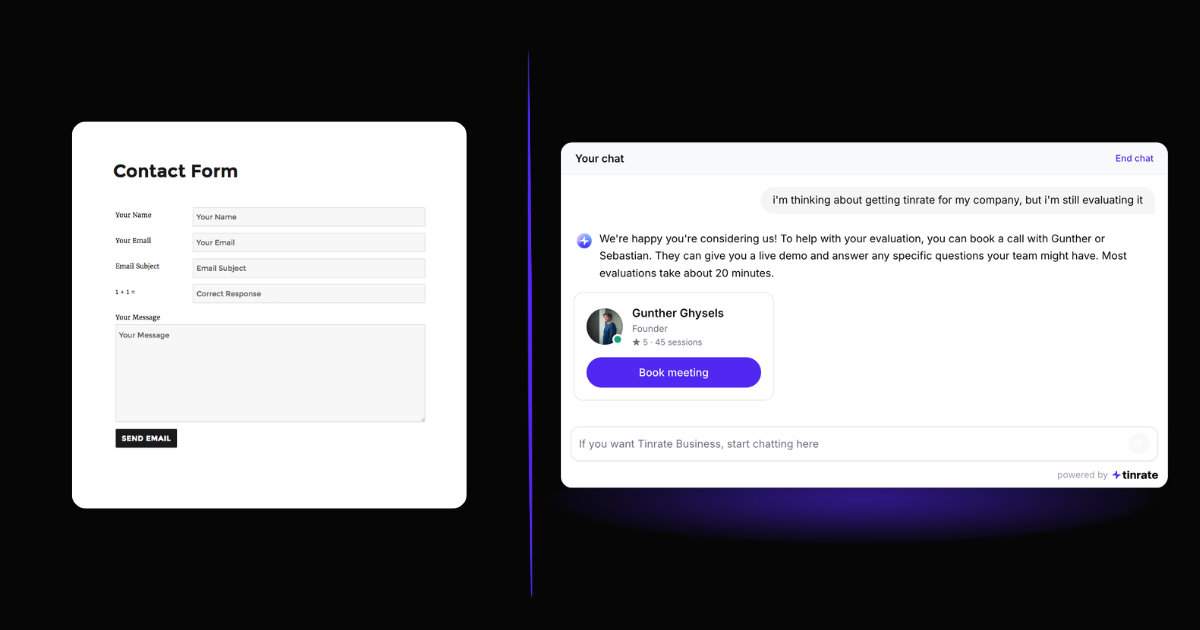
The fix is giving visitors somewhere to go the moment they have a question.
Not a form. A conversation.
When a visitor can type their question and get an immediate, accurate answer, from your own documentation, not a generic AI two things happen. First, they stay. Second, they tell you exactly what they need. The question they type is more valuable than anything a contact form would have captured, because it is honest and specific and unprompted.
And when they are ready to talk to a human, the path should be immediate: see a team member, pick a time, get confirmed. No waiting, no back-and-forth, no losing momentum.
This is what Tinrate Business does. An AI concierge on your front page, trained on your own documents, answering from your verified knowledge, routing qualified visitors to your team's calendar automatically.
The moment it goes live, you start seeing something you have never seen before: every question your market is asking about you. Not the questions that made it through a form. All of them.
The market intelligence you did not know you were missing
This is the part most companies do not think about until they see it for the first time.
When Tinrate Business is live on your website, your back-office dashboard shows you a log of every visitor conversation. The exact words they used. The specific doubts they expressed. The questions they asked before deciding whether to book a call.
For a growth team, this is gold. You can see which objections come up repeatedly and address them on the product page. You can see which features people ask about most and highlight them in your messaging. You can see where people get confused and fix it before it costs you another lead.
For a sales team, it means your reps enter every call pre-briefed. They know what the prospect asked. They know what they were told. They know where the prospect is in their decision. The discovery call becomes a real conversation instead of a questionnaire.
For a founder, it means you finally have a direct line to what your market actually thinks about your product, not filtered through a form, not filtered through a sales rep's memory, but raw and real and logged.
One more thing nobody is talking about yet
When Tinrate Business is live on your website, AI crawlers find structured, verified, conversational Q&A on your own domain. This is exactly the format AI engines weight most heavily when deciding which sources to cite in their answers.
Right now, when someone asks ChatGPT about your company, it either halluccinates or tells them it does not know. With Tinrate Business, your website becomes the authoritative source, because the right questions are being asked and answered on your own domain, in a format AI engines can read and cite.
Your competitors are invisible on AI search. You do not have to be.
Where to start
If 97% of your visitors are leaving without converting, the problem is not your product. It is not your pricing. It is not even your traffic.
It is that your website is frozen. It cannot have a conversation. And in 2026, a website that cannot have a conversation is a website that is losing.
Tinrate Business is now in early access. You can chat with our AI concierge directly on tinrate.com/business, ask it anything, see how it works in real time, and book a demo with our team if you want to see how it would look on your website.
The first conversation costs nothing. The leads you keep losing cost a lot more.